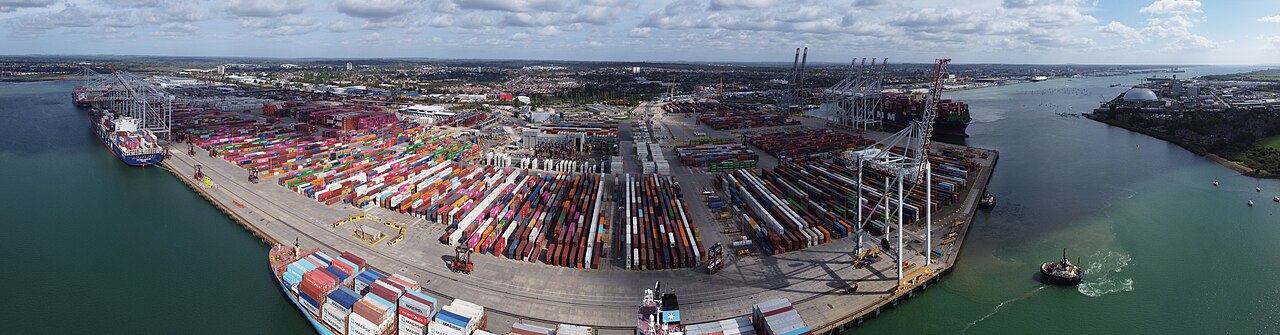
DP World has completed an expansion of the berth at its Posorja container terminal in Ecuador to 800 metres, finishing an infrastructure program worth around 200 million dollars that will raise the Pacific coast gateway’s annual handling capacity to 1.4 million TEU.
The Dubai-based port operator confirmed the milestone this week, adding a new long-outreach ship-to-shore crane and three hybrid rubber-tyred gantry cranes at the facility near Guayaquil, bringing the terminal’s total equipment to seven ship-to-shore cranes and 18 rubber-tyred gantries.
New Crane and Equipment
The new ship-to-shore crane can lift up to 65 tonnes per move, is powered entirely by electricity, and is built to service container vessels up to 400 metres long with 24 rows across the deck and capacities of between 20,000 and 24,000 TEU. Posorja also added empty-container handlers, electric internal terminal vehicles and roughly 50 percent more reefer plug capacity to support Ecuador’s refrigerated export trade. The equipment forms part of a broader push to prepare the terminal for a new generation of ultra-large vessels calling on South America’s Pacific coast.
DP World said the new hybrid yard cranes will cut diesel consumption at the terminal by 40 percent and avoid more than 900 tonnes of carbon dioxide emissions annually. The equipment upgrades are expected to be fully operational by early 2027, when the capacity increase to 1.4 million TEU takes full effect. The investment also covered civil works extending the quay itself to 800 metres, completing a construction program DP World began several years earlier.
Capacity Growth on Ecuador’s Pacific Coast
The works mark the latest phase of a multi-year expansion that progressed from a berth of 467.5 metres before construction began toward an interim 700-metre stage reached earlier in 2026. Once fully online, the expanded capacity represents roughly a 40 percent increase in annual throughput. Posorja handled nearly 956,000 TEU in the most recent full year on record, underscoring the scale of growth DP World is targeting.
Carlos Merino, DP World’s chief executive for Ecuador, Peru and Colombia, said the investment strengthens the terminal’s ability to handle the largest vessels operating on global trade routes. DP World’s cumulative investment in Ecuador now totals around 500 million dollars, covering the terminal’s construction, a 21-kilometre access road and a dedicated deep-draft access channel. Merino has previously said expanding the berth would help keep Ecuador competitive as shipping lines deploy larger vessels and open new Pacific trade routes.
Strategic and Security Dimension
Posorja has become Ecuador’s principal container gateway for temperature-sensitive agricultural exports such as bananas and shrimp, cargoes that depend on reliable reefer capacity. The latest round of investment added more than 900 new refrigerated plugs alongside the new cranes and transport vehicles, directly expanding that capacity. Ecuador’s seafood and produce exporters rely on fast, high-volume handling at ports like Posorja to reach Asian and North American markets.
During an earlier inauguration ceremony marking the terminal’s 700-metre milestone, DP World and Ecuador’s navy laid the foundation stone for a new naval station at Posorja. The facility, developed jointly with the navy, is intended to support maritime security through enhanced control, surveillance and protection of Ecuador’s coastal waters. The pairing of commercial and security infrastructure reflects wider efforts by Pacific coast nations to safeguard growing container traffic.
Why it matters
The Posorja upgrade illustrates how Latin American Pacific ports are racing to accommodate ever-larger container ships as carriers deploy bigger tonnage on Asia-South America routes. For Ecuador, additional berth length and reefer capacity directly benefits its banana, shrimp and produce export sectors, which depend on reliable, high-capacity sea links to reach distant markets. The expansion also reflects DP World’s continued buildout of a Latin American network spanning Ecuador, Peru and Colombia as global terminal operators compete for market share amid rising transpacific trade volumes.
Source: DataPortuaria