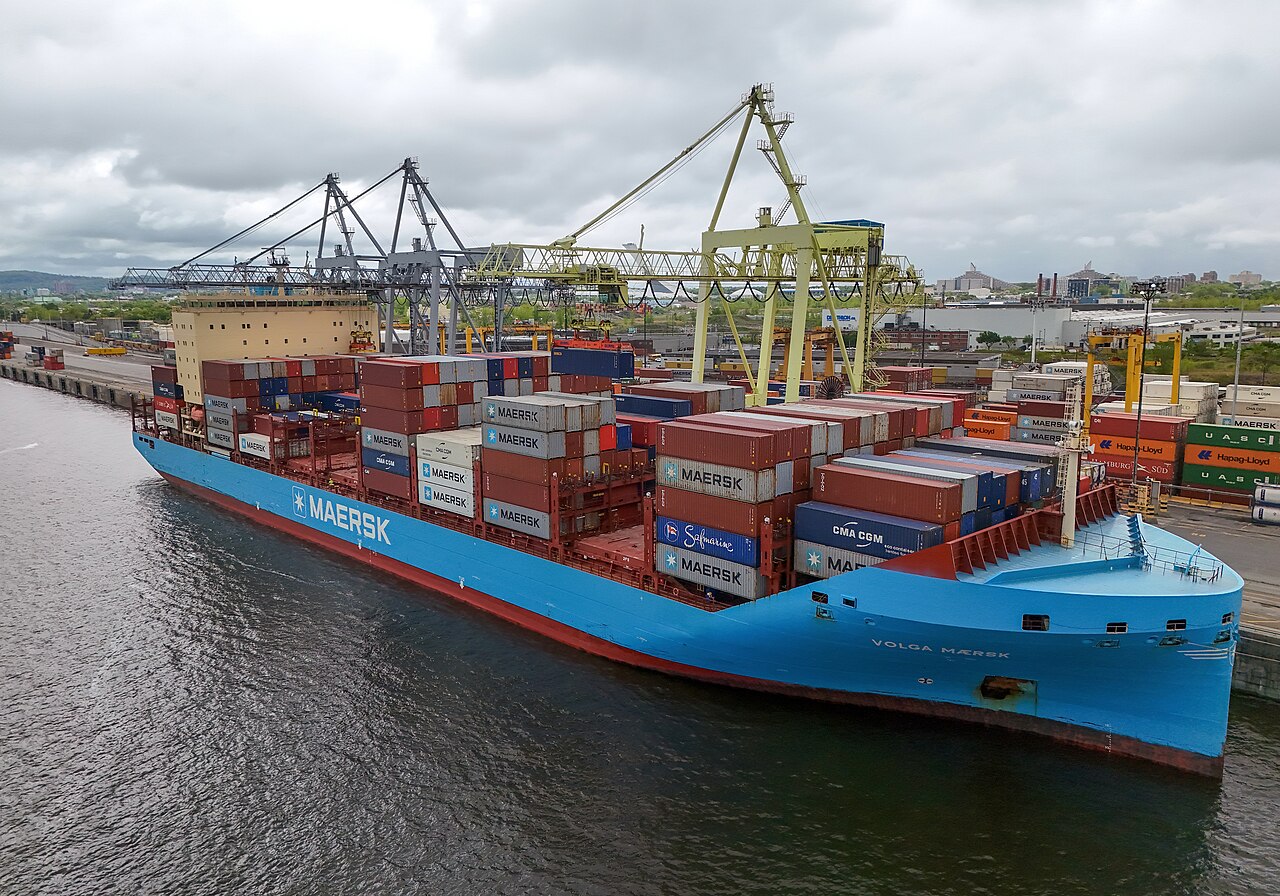
AP Moller-Maersk has confirmed an order for 12 ultra-large containerships of 24,000 TEU, marking its entry into the largest boxship segment with an investment estimated at around $2.9 billion. The Copenhagen-based group said the dual-fuel vessels would be delivered in 2030 and 2031, becoming the biggest ships in its fleet.
A Maersk spokesperson confirmed the order to Reuters on November 24, ending weeks of market speculation about the Danish carrier’s return to the ultra-large vessel category. Each ship will be equipped with engines capable of running on conventional marine fuel or LNG, with the 12-ship series adding 288,000 TEU of nominal capacity to Maersk’s fleet once delivered.
Order Details and Vessel Specifications
The newbuildings will carry 24,000 TEU, surpassing Maersk’s current largest ships, the second-generation Triple-E vessels, which have capacity of around 20,500 TEU. Shipbroking sources say the confirmed order forms part of a larger contract covering 12 firm vessels and 12 optional 24,000-TEU ships, meaning the programme could eventually double in size. Lloyd’s List estimated the confirmed investment at a minimum of $2.76 billion, while Alphaliner had earlier put the cost at roughly $240 million per vessel.
Market reporting in the weeks before confirmation pointed to Maersk negotiating exclusively with Chinese shipyards, with Hengli Heavy Industries identified as the builder securing the contract on pricing grounds. The vessels will be fitted with dual-fuel engines capable of operating on conventional bunker fuel or LNG, continuing the carrier’s recent preference for gas-fuelled propulsion over methanol in its newest tonnage.
Fleet Strategy and 2026 Newbuilding Surge
The megamax order extends a rapid acceleration in Maersk’s fleet investment this year. In September the company confirmed contracts for 26 LNG dual-fuel ships of 18,600 TEU, scheduled for delivery in 2029 and 2030, following an earlier order in February for eight vessels in the same size range. Including the latest series, Maersk has now confirmed 46 containership newbuildings during 2026 alone, representing a combined nominal capacity of more than 920,000 TEU.
Alphaliner data shows Maersk’s overall orderbook now comprises 137 vessels with a combined capacity of 1.8 million TEU. The shift marks a departure from the carrier’s prior strategy of holding overall fleet capacity steady while focusing purely on replacing older tonnage, as CEO Vincent Clerc had indicated the group had extracted as much growth as possible from its existing ships.
Industry Context and Orderbook Growth
The order lands amid record contracting across the container sector, with the global newbuilding orderbook already exceeding 15 million TEU and continuing to climb toward 16 million TEU before year-end. Alphaliner has tracked roughly 40 additional large containerships expected to join the pipeline involving Maersk, Yang Ming, CMA CGM and MSC, with LNG dual-fuel designs now accounting for 56 percent of contracted capacity compared with 12 percent for methanol dual-fuel vessels.
Rival carrier CMA CGM is closing the capacity gap with Maersk, with its fleet approaching 4.5 million TEU, and analysts suggest it could surpass Maersk’s total capacity within months. The wave of megamax ordering has also raised concerns among some industry observers about overcapacity risk once the current newbuilding wave reaches the water in 2029 through 2031.
Why it matters
Maersk’s entry into the 24,000 TEU category signals a structural shift in the world’s second-largest container line’s fleet strategy, abandoning its long-held capacity ceiling in favor of newer, larger, dual-fuel tonnage. The scale of the 2026 ordering spree, combined with similar moves from CMA CGM, MSC and Yang Ming, is pushing the global containership orderbook toward 16 million TEU, raising questions about future overcapacity even as carriers bet on LNG propulsion to meet tightening emissions rules. The outcome will shape freight rates, shipyard capacity in China, and the pace of the industry’s shift away from conventional bunker fuel over the coming decade.
Source: Splash247