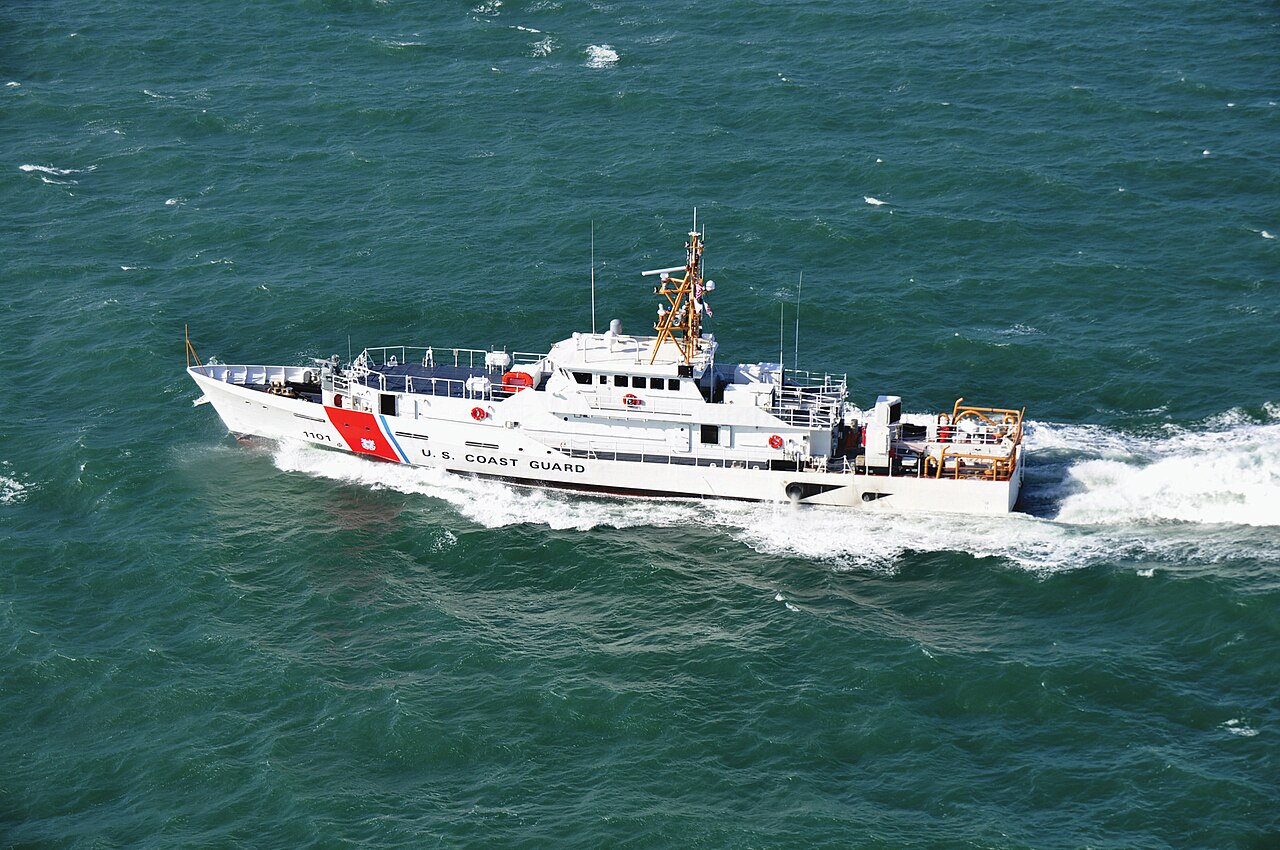
The US Coast Guard commissioned the Sentinel-class fast response cutter USCGC Marvin Perrett during a ceremony in New Orleans on November 19, homeporting the vessel in San Juan, Puerto Rico, where it becomes the sixth such cutter based in the territory. The commissioning was the 64th delivery of the class by Bollinger Shipyards and comes as the Coast Guard continues to expand its Caribbean patrol presence.
Separately, the US Navy’s fiscal 2027 shipbuilding plan calls for the purchase of 79 FF(X) frigates through fiscal year 2056, according to a Congressional Budget Office analysis published November 19. The frigate class, derived from the same cutter design lineage, is intended to begin with a small initial batch of vessels ordered between fiscal 2027 and 2031 before ramping up to three orders a year from 2032.
New Cutter Joins Caribbean Fleet
The Coast Guard took delivery of USCGC Marvin Perrett in Key West, Florida, on September 10, ahead of its formal commissioning in New Orleans on November 19. Bollinger Shipyards built the vessel as the 64th Sentinel-class fast response cutter produced for the service, continuing a program that has steadily replaced older patrol boat classes across US coastal and offshore commands.
Homeporting the cutter in San Juan brings the number of Sentinel-class vessels based in Puerto Rico to six, reinforcing the Coast Guard’s footprint in the Caribbean. The vessel is designated to operate across the Caribbean and the US southern maritime approaches, an area the service has prioritized for patrol and interdiction operations in recent years.
Navy’s FF(X) Frigate Program Takes Shape
The Congressional Budget Office analysis, released November 19, describes a Navy plan to acquire 79 FF(X) frigates over a three-decade horizon running through fiscal year 2056. The program envisions a gradual ramp-up, with sustained production reaching three frigates ordered annually starting in fiscal year 2032.
In the near term, the Navy proposes ordering four of the cutter-derived frigates between fiscal 2027 and fiscal 2031, with one vessel each in 2027 and 2029 and two in 2031. The CBO report outlines a plan to distribute construction of the frigates among two or possibly three shipyards, a structure intended to manage industrial capacity and schedule risk across the long build-out.
Shipbuilding Capacity and Program Context
The Sentinel-class program has served as the backbone of Coast Guard fleet recapitalization, with Bollinger Shipyards serving as the lead builder delivering vessels in steady succession over more than a decade. Each cutter is designed to patrol coastal and near-shore waters, taking on missions ranging from maritime law enforcement to search and rescue that previously fell to older, smaller patrol boats.
The Navy’s decision to draw on a related hull design for its FF(X) frigate concept reflects a broader effort to control costs and shorten development timelines for surface combatants. The multi-decade scope of the CBO-reviewed plan signals a long industrial commitment, though the pace of early orders through 2031 remains modest compared with the production rate envisioned from the 2030s onward.
Why it matters
The commissioning underscores steady, incremental expansion of US Coast Guard patrol capacity in the Caribbean, an area central to counter-narcotics and migration enforcement missions. The Navy’s parallel 79-ship FF(X) frigate plan, spanning three decades, signals a major long-term shipbuilding commitment that will shape US surface fleet capacity and sustain yard workloads for Bollinger-linked and allied shipbuilders well into mid-century. Together the developments illustrate how cutter-derived hull designs are increasingly shared across US maritime security and naval shipbuilding programs to manage cost and schedule risk.
Source: Baird Maritime