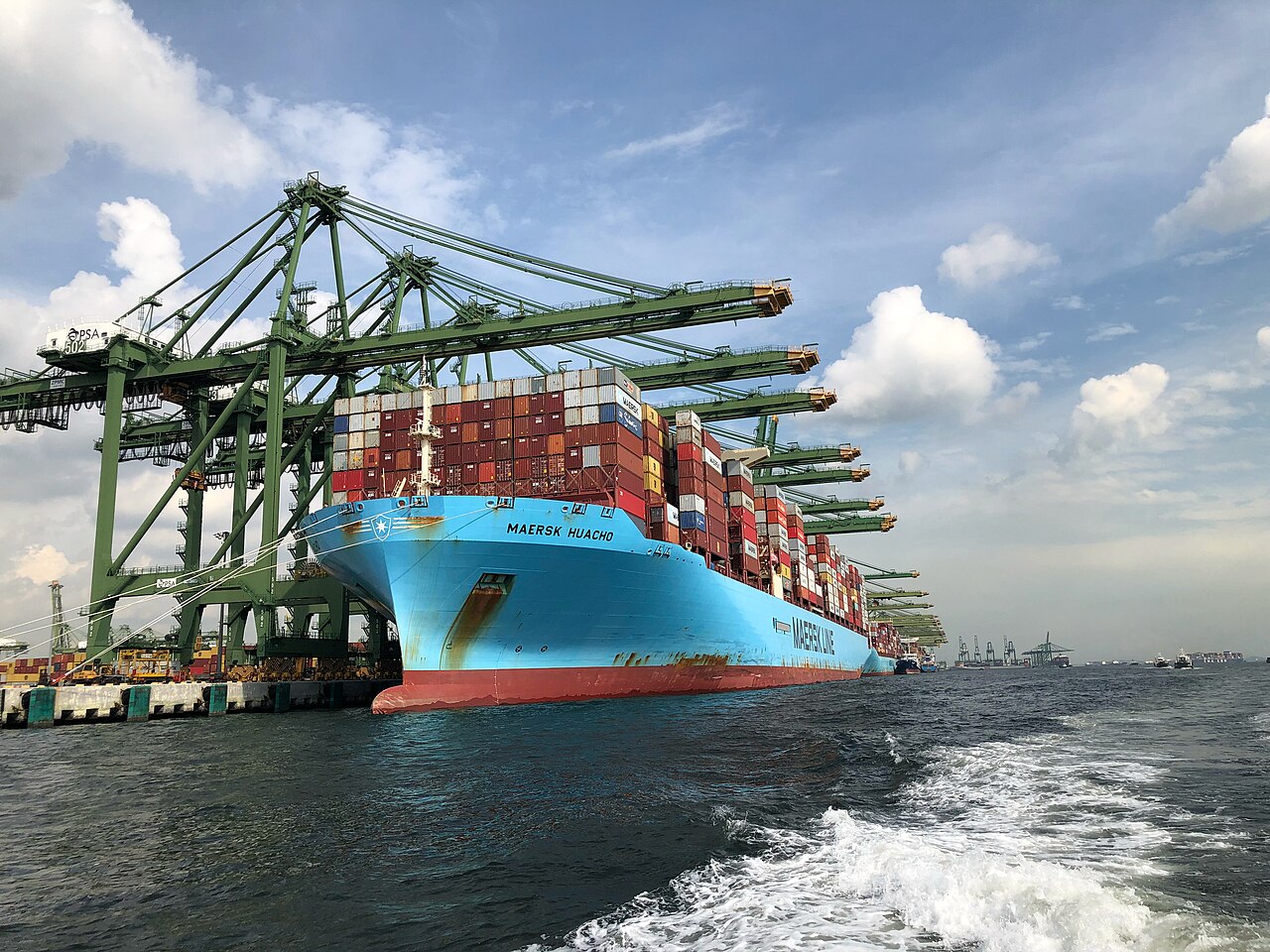
Maersk, bunker supplier Golden Island Pte Ltd and PSA Singapore completed Singapore’s first ethanol bunkering operation on October 17 at PSA’s Pasir Panjang Terminal, with support from the Maritime and Port Authority of Singapore (MPA). The Singapore-registered dual-fuel container vessel Maersk Halifax received approximately 5,000 metric tonnes of ISCC-certified bioethanol, making it the largest single ethanol bunkering transfer recorded anywhere to date.
The fuel was supplied from Golden Island’s Singapore-registered IMO Type II chemical tanker M.T. Golden Centaurus using a mass flow meter (MFM) system, while the operation was conducted simultaneously with ongoing cargo handling on the containership, a practice known in the industry as SIMOPS. The trial is intended to generate data on whether Singapore’s existing methanol bunkering framework can be adapted to cover ethanol as an emerging marine fuel.
Operation Details and Technical Setup
The bunkering took place under full operational conditions, with container handling continuing on the Maersk Halifax while the Golden Centaurus transferred bioethanol alongside. Ahead of the job, Maersk, Golden Island, PSA Singapore and MPA held a hazard identification and operability workshop, and crews were trained specifically in ethanol handling and emergency response procedures, drawing on experience already built up through methanol bunkering in the port.
Mass flow meters, the standard measurement technology already certified for methanol transfers, were used to track the ethanol transfer in real time. Stolthaven Singapore handled storage and onward transfer of the fuel ahead of delivery to the Golden Centaurus. MPA said the data collected will help assess the suitability of Technical Reference 129, the port’s existing methanol bunkering standard, for application to ethanol operations.
Industry and Regulatory Reactions
MPA chief executive Ang Wee Keong said the operation would help the port authority test how its existing methanol bunkering infrastructure and experience could support ethanol as another emerging marine fuel, and would inform standards and procedures for future ethanol bunkering activity. Golden Island managing director Johnny Tan said the company’s crew and the Golden Centaurus built directly on lessons learned from methanol bunkering, applying the same safety-first discipline to execute the largest single ethanol bunker delivered to date.
Singapore’s Senior Minister of State for Law and Transport, Murali Pillai, had previewed the operation during a speech at the SIBCON bunkering conference earlier in the week. Golden Island is one of three companies holding an MPA licence to supply methanol as a marine fuel in the port, with that licence running for five years from January 2026, underscoring the city-state’s strategy of leveraging its alternative-fuel bunkering infrastructure across multiple fuel types rather than building separate systems from scratch.
Context Within Singapore’s Bunkering Market
Singapore remains the world’s largest bunkering hub, a position reinforced by its early investment in alternative marine fuel infrastructure including methanol, LNG and now ethanol. The ethanol trial builds directly on groundwork laid for methanol bunkering, which MPA has been developing through licensed suppliers and standardized technical references since the start of 2026.
The Maersk Halifax is one of the shipping line’s dual-fuel vessels capable of running on methanol, and its use in this ethanol trial signals how carriers are testing flexibility across alternative fuel types as the industry works toward IMO emissions targets. Ethanol shares handling characteristics with methanol and falls under existing IMO safety guidelines for methyl and ethyl alcohol fuels, a factor that eased the technical path toward this record-setting transfer.
Why it matters
The operation marks a concrete step in diversifying marine fuel options beyond LNG and methanol, as container lines and bunker suppliers seek pathways to comply with tightening IMO decarbonization rules. By reusing methanol bunkering infrastructure, training and technical standards for ethanol, Singapore aims to shorten the lead time for scaling up a new fuel pathway rather than building separate systems, a model other major bunkering ports may look to replicate. For shipowners, the successful SIMOPS transfer demonstrates that alternative-fuel bunkering can be conducted without halting cargo operations, a key factor in keeping vessel turnaround times competitive as the fleet transitions to lower-carbon fuels.