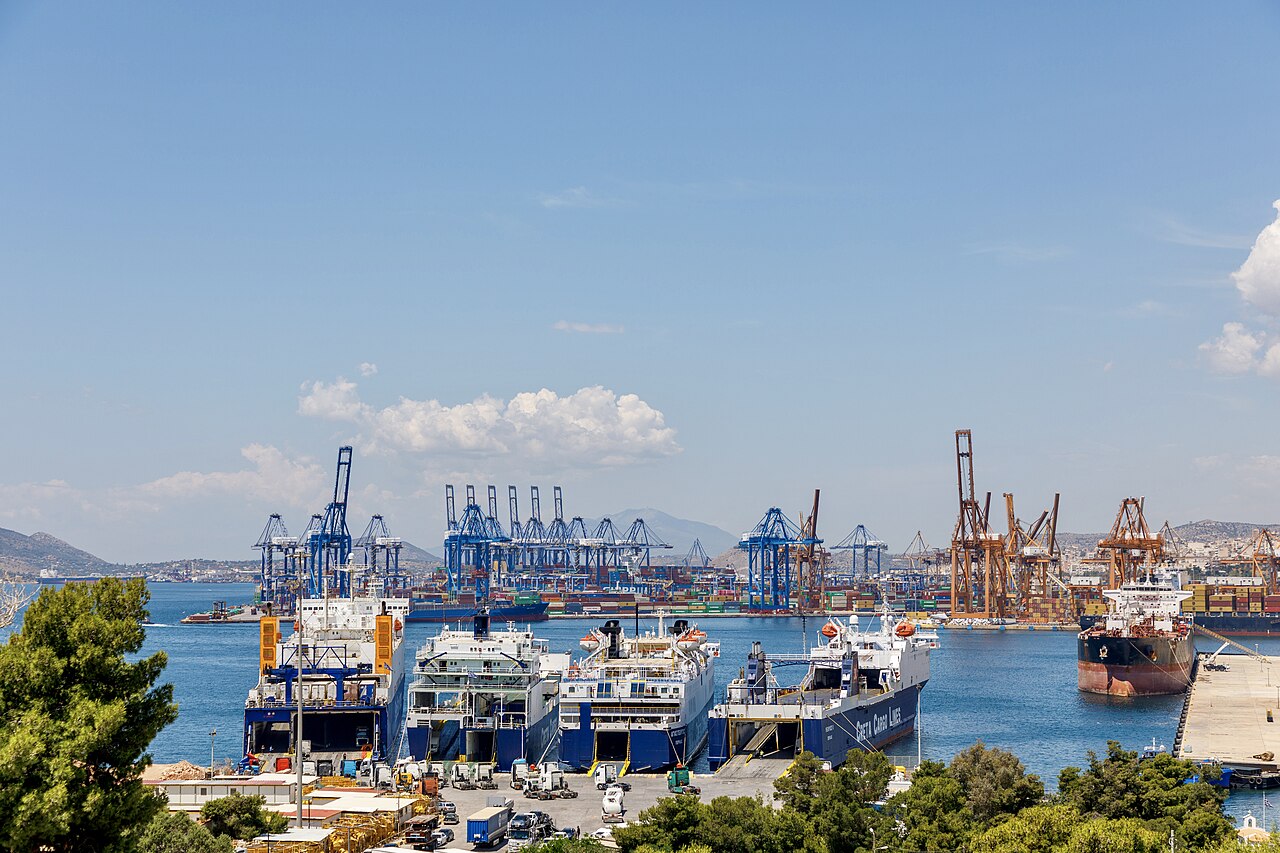
Container throughput at Piers II and III of the Port of Piraeus rose 15.3% year-on-year in September, reaching approximately 367,000 TEUs, as Greece’s largest port continued a gradual recovery despite most container lines still diverting around the Cape of Good Hope to avoid the Red Sea. The figures, released by COSCO Shipping Ports, cover the terminals operated through its subsidiary Piraeus Container Terminal (PCT).
The improvement came alongside an increase in calls at the Mediterranean hub and expectations that the first vessel to transit the Suez Canal en route to Piraeus since the Red Sea crisis will arrive in the final ten days of October, according to Naftemporiki. The prospect of renewed Suez traffic is seen as opening new avenues for further cargo recovery at the port.
September Volumes Extend Recovery
September throughput at Terminals II and III reached approximately 367,000 TEUs, compared with 318,000 TEUs in the same month of 2025, a 15.3% annual increase according to COSCO Shipping Ports data. The result followed a similarly strong August, when the two terminals handled 372,100 TEUs, up 18% from 315,500 TEUs a year earlier, as the Mediterranean market continued to track the cautious resumption of Suez Canal services.
Naftemporiki separately reported that monthly throughput tied to the gradually resuming Suez-linked routings had risen by about 25%, climbing from roughly 40,000 to approximately 50,000 TEUs, pointing to a steady pickup in activity along that corridor. The trend marks a reversal from earlier in 2026, when Piraeus volumes had periodically lagged prior-year levels amid soft Mediterranean demand and adverse weather.
Suez Canal Return Still Gradual
Most container ships continue to avoid the Red Sea, opting instead for the longer route around the Cape of Good Hope on voyages between Asia and Europe, keeping the broader shipping landscape in flux even as Piraeus posts gains. The expected arrival of the first vessel routed via the Suez Canal to Piraeus in late October would mark a tangible milestone in the gradual normalization of that corridor rather than a wholesale shift back by carriers.
Port operators and market watchers have treated each incremental return to Suez as a signal rather than a turning point, given that the broader return of major containership operators to the Red Sea route remains uneven. For Piraeus, which sits on the Asia-Europe trade lane, any sustained resumption of Suez transits carries direct implications for transit times and competitive positioning against other Mediterranean and northern European gateways.
COSCO’s Wider Network and Piraeus Position
Piraeus has grown under COSCO Shipping into the fourth-largest container port, the second-largest cruise homeport and the largest ferry port in Europe, alongside its role as a roll-on/roll-off automobile hub and ship-repair center in the Eastern Mediterranean. COSCO has invested more than 10 billion yuan, or roughly 1.47 billion dollars, in the port since taking over operations, with Piraeus Port Authority posting total revenue of approximately 251 million euros in 2025, an 8.6% year-on-year increase, and operating profit of 132 million euros.
The September gains at Piraeus mirrored stronger results across COSCO Shipping Ports’ global network, where total throughput across 38 terminals worldwide rose 15.7% in September to around 11 million TEUs, up from 9.5 million TEUs a year earlier, while overseas facilities grew 20.7% year-on-year. For the first nine months of 2026, throughput across the group’s portfolio reached approximately 94 million TEUs, up 8.5% from 86.5 million TEUs in the same period of 2025.
Why it matters
Piraeus’s container recovery offers an early market signal on whether Asia-Europe box trade is beginning to normalize following years of Red Sea-driven disruption and Cape of Good Hope diversions. A confirmed return of Suez-routed calls would reinforce Piraeus’s position as a Mediterranean transshipment hub competing with Valencia, Algeciras and Hamburg, with direct consequences for Greek port revenue, COSCO’s regional investment returns and the pricing and scheduling decisions of major container carriers still weighing the risks of the Red Sea route.
Source: Naftemporiki